
What is a Motor Bearing?
A motor bearing is a precision mechanical component that connects the stationary motor housing to the rotating shaft. Its primary function is to reduce friction, support radial and axial loads, and ensure the rotor remains perfectly centered to prevent energy loss and vibration.
Introduction
Motor bearings are one of those components people rarely notice, quietly enabling smooth, efficient, and reliable operation of engines, pumps, gearboxes, compressors, and industrial robots. The correct bearing is crucial not only for reducing friction and supporting loads but also for minimizing energy loss, vibration, and potential equipment failures.
Are you struggling with premature motor failure?
As motors become more advanced across industries, choosing the wrong bearing can lead to costly downtime. This guide delivers a comprehensive review of everything you need to know:
- The 4 essential types of motor bearings.
- How to match bearings to load and speed.
- Why electrical erosion is the new #1 killer of bearings.
What Are Motor Bearings and Why Are They Important?
A motor bearing is a precision mechanical component that supports the rotating shaft inside a motor, facilitating low-friction motion between stationary and moving parts. Motor bearings play several key roles:
- Support for Radial and Axial Loads: They carry both the radial load (perpendicular to the shaft) and axial load (along the shaft) produced during motor operation.
- Friction Reduction: Bearings use rolling elements—balls or rollers—allowing smooth shaft rotation and minimizing wear and heat generation.
- Vibration Dampening: By absorbing shocks and oscillations, bearings protect the motor and its components from vibration-induced damage.
- Shaft Alignment: Precise machining ensures the motor shaft remains centered and concentric within the housing, safeguarding performance and reducing noise.
Efficient bearings maximize energy transfer, prevent motor overheating, and dramatically increase operational lifespan.
Core Functions of Motor Bearings
- Load Support: Ensuring reliable transmission of radial and axial forces.
- Friction Minimization: Using rolling elements to lower resistance and heat.
- Bearing Vibration Control: Minimizing rotor runout and dampening mechanical resonance.
- Shaft Positioning and Alignment: Maintaining correct shaft and rotor geometry.
- Energy Efficiency: Reducing power losses due to friction or misalignment.
Common Types of Electric Motor Bearings
While thousands of bearing types exist, electric motors primarily rely on four distinct designs to handle high speeds and specific load conditions. Below is a comparison of the industry standards.
| Bearing Type | Best For… | Common Application |
|---|---|---|
| Deep Groove Ball Bearings (The Industry Standard) |
High speeds, moderate radial & axial loads. | Standard IEC/NEMA motors, Fans, Pumps. |
| Cylindrical Roller Bearings (Heavy Duty) |
Heavy radial loads at medium speeds. | Large Motors (above 100HP), Belt Drives. |
| Angular Contact Bearings | High thrust (axial) loads in one direction. | Vertical Pump Motors, Compressors. |
| Spherical Roller Bearings | Self-aligning for heavy shock loads. | Crushers, Shakers, Wind Turbines. |
1. Deep Groove Ball Bearings (Most Common)
Overview: The most widely used bearing in electric motors. They feature deep raceway grooves and a close conformity between the balls and raceways.
Why use them: They generate very low friction, making them ideal for high-speed operation while minimizing noise and vibration.
Insulated Option: Essential for VFD-driven motors to prevent electrical fluting.
2. Cylindrical Roller Bearings (NU/NJ Series)
Overview: Instead of balls, these use cylinders as rolling elements, providing a larger contact area.
Why use them: Commonly found on the “drive end” (DE) of large motors where belt drives or heavy radial loads would crush a standard ball bearing.
Note: They handle radial loads exceptionally well but standard NU/N types cannot handle axial (thrust) loads.
3. Angular Contact Ball Bearings
Overview: Designed with raceways displaced relative to each other in the direction of the bearing axis.
Why use them: Specifically for Vertical Motors (like commercial pumps) where the bearing must support the weight of the rotor (high axial load) while spinning at high speeds.
4. Spherical Roller Bearings
Overview: These bearings have two rows of rollers and a common sphered outer raceway.
Why use them: They are self-aligning, meaning they can tolerate shaft misalignment. You will often find these in heavy-duty applications like mining motors, crushers, or wind turbine main shafts.
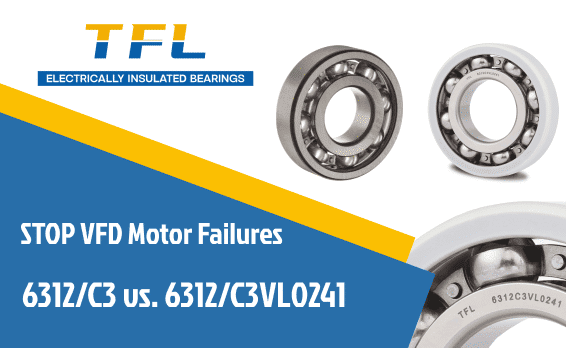
5. Insulated Bearings (The Modern Standard)
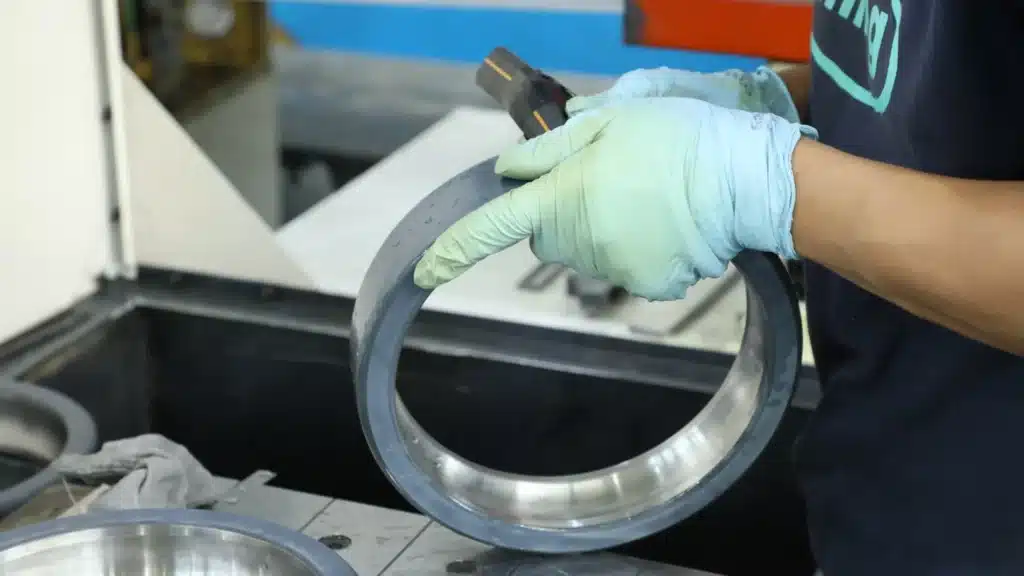
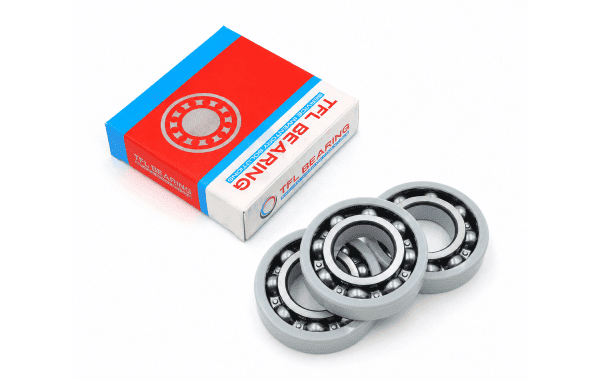
Overview: Mechanically identical to the types above (usually Deep Groove or Cylindrical) but coated with a ceramic insulation layer (Aluminum Oxide).
Why use them: In modern industry, Variable Frequency Drives (VFDs) create stray shaft currents. Standard bearings fail quickly in these conditions. Insulated bearings are the only drop-in replacement that stops this failure mode.
Need Bearings That Last Longer?
Standard bearings fail under electrical stress. Upgrade to TFL Insulated Bearings to protect your motors from VFD-induced currents.
Motor Bearing Materials and Construction
Motor bearings are crafted from a range of materials tailored for the environment, load, and longevity:
- Bearing Steel (Chrome Steel AISI 52100): Standard for most industrial bearings due to its high hardness and durability.
- Stainless Steel: Used for corrosion-resistant applications.
- Ceramic: Provides high heat and electrical insulation (in hybrid or fully ceramic bearings), ideal for high-speed or electrically noisy environments.
- Bronze or Composite: For sleeve bearings and extreme corrosion resistance.
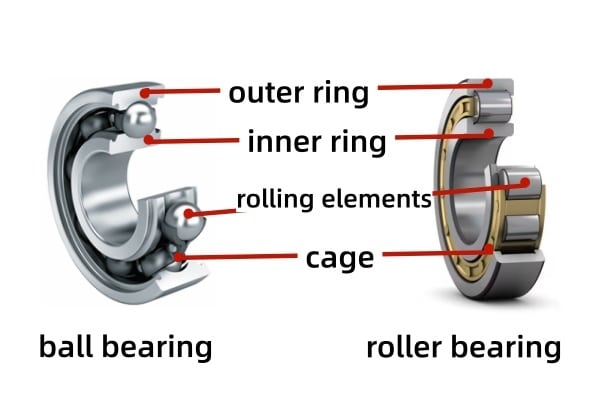
Bearings consist of:
- Inner Ring: Mounted on the shaft.
- Outer Ring: Pressed into the housing.
- Rolling Elements: Balls, rollers, or needles between the rings.
- Cage: Maintains spacing of rolling elements for even load and smooth motion.
Key Selection Factors for Motor Bearings
1. Load Type & Magnitude
Radial Load: Perpendicular to shaft axis—handled best by deep groove, cylindrical, and spherical bearings.
Axial (Thrust) Load: Along the shaft—handled by angular contact, thrust, and tapered roller bearings.
Combined Loads: Choose angular contact or spherical/tapered roller bearings.
2. Rotational Speed
High-speed motors require low-friction bearings (ball or hybrid ceramic). For heavy loads at low speeds, cylindrical or spherical roller bearings may be best.
3. Shaft and Housing Fit
Precise tolerances prevent shaft play, vibration, and premature failure. Bearing fit classes (e.g., h6, H7) must match application and manufacturer guidelines.
4. Environmental Conditions
Contamination: Sealed (2RS) or shielded (ZZ) bearings for dusty or moist environments.
Temperature: Special lubricants and materials for high-temperature use.
Corrosion Resistance: Stainless steel or ceramic for aggressive or wet environments.
5. Lubrication and Maintenance
Choose pre-lubricated for “fit-and-forget” applications; for high-demand situations, install re-lubrication systems. Monitoring and maintaining lubrication are critical to maximize bearing life.
Common Motor Bearing Failure Modes
EXPERT INSIGHT: In modern VFD-driven motors, up to 50% of bearing failures are caused by Electrical Erosion (shaft voltage). Standard steel bearings cannot stop this. Using Electrically Insulated Bearings is the only permanent fix to prevent fluting and premature failure.
- Wear & Fatigue: Resulting from poor lubrication, misalignment, or overloading.
- Contamination: Ingress of dirt, moisture, or chemicals degrades surfaces.
- Electrical Erosion: Stray currents cause pitting and fluting (prevent with insulated or hybrid bearings).
- Brinelling: Permanent denting from impact or shock loads.
- Lubricant Degradation: Leads to overheating and failure.
- Prevention Tips: Proper mounting, regular inspection, vibration analysis, and using the correct bearing type for conditions prevent most failures.
Steps to Selecting the Optimal Motor Bearing
- Define Application Requirements: Load, speed, size, and expected life.
- Match Bearing Type: Based on load type, speed, and environment.
- Check Fit and Tolerance: Consult manufacturer fit charts and guidelines.
- Specify Lubrication and Sealing: Match to maintenance schedule and environmental risks.
- Consider Special Requirements: Insulated bearings for VFD/inverter-driven motors, corrosion-resistant types for food/chemical industries.
- Consult Manufacturer Data: Use catalogs or bearing selection software for technical validation.
- Plan for Monitoring & Maintenance: Choose compatible sensors for vibration, temperature, or lubrication analysis.
Optimize Your Motor Performance with TFL Insulated Bearings
As we have explored, selecting the right bearing is pivotal for preventing failure modes like electrical erosion and ensuring the longevity of your machinery. At TFL Insulated Bearings, we specialize in providing high-quality, insulated solutions designed to withstand the stray currents common in modern VFD-driven motors.
Ready to enhance your equipment’s reliability?
- Contact Us today for a technical consultation.
- Send us an email at [email protected] to request a catalog or quote.
- Call us directly at +86 15806631151 to speak with our engineering team.
Frequently Asked Questions
What is the most common bearing used in electric motors?
Deep Groove Ball Bearings are the most common type used in electric motors due to their versatility, low friction, and ability to handle both radial and axial loads at high speeds.
What causes bearing failure in electric motors?
The most common causes include improper lubrication, contamination, misalignment, and electrical erosion (shaft currents). Electrical erosion is particularly prevalent in VFD-driven motors and requires insulated bearings to prevent.
How do I choose between a ball bearing and a roller bearing?
Choose a ball bearing for high-speed, light-to-moderate load applications. Choose a roller bearing (cylindrical or spherical) for heavy radial loads or applications involving shock and vibration, typically at lower speeds.